
INSIGHTS / LEADERSHIP & PERFORMANCE
Autonomous work is
scaling faster than
accountable authority.
Most enterprises can name the artificial intelligence
systems they have approved. Far fewer can identify every
material decision those systems are now permitted to
shape, initiate or complete.
10 AUGUST 2026 14 MIN READ

DECISION
What judgement is being exercised,
and what enterprise consequence
can follow?
AUTHORITY
Who gave the system permission to
recommend, initiate, approve or
complete the decision?
ACCOUNTABILITY
Who remains answerable when the
outcome is produced without
meaningful human judgement?
ON THIS PAGE
Introduction
01
Introduction
Why most AI governance
starts in the wrong place
The governance unit is no longer the model. It is the decision.
How accountability quietly disappears
Where conventional governance begins to fail
A Decision
The Autonomous Decision Ledger
The Governance Architecture Review and board scoring method
Questions every board should answer
Closing perspective
The first difficult question is usually answered with the name of a department.
Technology owns the system.
Operations owns the process.
Risk owns the policy.
Compliance reviews the exceptions.
Then somebody asks who owns the decision, the room becomes less certain.
That moment is increasingly common because most organisations are still governing the technology they purchased rather than the authority it now exercises.They review the vendor, test the model, restrict access, approve the use case and monitor incidents. Those controls matter. Some are indispensable.
They do not, on their own, establish who authorised the enterprise to act.
That distinction was easier to ignore when artificial intelligence was largely analytical. A model examined information and produced a forecast, recommendation or draft. An employee considered the output and decided what happened next.
Responsibility remained visible. Autonomous systems alter that arrangement.
An agent may now identify an issue, interpret policy, select an action, communicate with another system and complete a workflow without waiting for an employee to intervene.
The work moves faster. Formal accountability often stays where it was.
On the organisation chart, the executive still owns the function. The manager still owns the process. The employee may still appear inside the workflow.
Operationally, the system may already be deciding:
which customer receives compensation
which supplier is prioritised
which invoice is delayed
which candidate proceeds
which exception is escalated
which risk receives human attention
which external commitment is made
Each decision can look modest in isolation.
At scale, the pattern is different. Judgement has moved from people into systems, while the architecture through which authority is delegated has barely changed. This normally remains invisible while the outcomes are favourable.
The customer accepts the resolution. The supplier fulfils the order. The budget remains within tolerance. A dashboard reports faster processing and lower cost.
Nobody asks who made the decision because the decision appears to have worked.
Then one outcome is challenged.
A regulator asks why an exception was approved. An employee disputes a recommendation. A supplier alleges that the company created contradictory obligations. A customer asks how a material decision was reached.
The organisation starts tracing the workflow backwards, however, by that point, accountability is being reconstructed after the event.
Boards should not need an incident before they can see where autonomous judgement is being exercised.
The governing unit should therefore be the decision itself: what was decided, what authority permitted it, who carried the consequence and who remained answerable.
A company can have excellent technology controls and still be unable to account properly for what it did.
A company can govern every AI system it uses and still fail to govern what the company actually does.
02
Why most AI governance starts in the wrong place
Most AI governance programmes begin with a reasonable question:
How do we use artificial intelligence safely?
The answer usually produces familiar controls.
Approved tools.
Data restrictions.
Vendor due diligence.
Model testing.
Deployment committees.
Human review requirements.
Cybersecurity standards.
Acceptable use policies.
The problem is not that these controls are misguided. The problem is that they mainly govern the means.
A model can operate exactly as designed and still sit inside a decision the board would never knowingly delegate.
Consider two systems built on the same underlying technology.
The first drafts an internal meeting summary for an employee to review.
The second identifies a disputed supplier invoice, interprets policy and instructs the payment system to withhold funds.
Technically, the systems may be similar. From a governance perspective, they are nowhere near each other. One assists an employee. The other changes the commercial position of the enterprise.
Yet many organisations would record both as approved applications of the same model family, subject to broadly similar technology, data and vendor controls.
That classification misses the important part. The board does not merely need to know whether the model is reliable. It needs to know whether the organisation intended to delegate this particular judgement, in these circumstances, against these stakeholders and within these limits.
Autonomy also tends to enter through the side doors.
A customer operations team introduces an agent to reduce response times.
Finance automates part of expense control.
Procurement connects a supplier platform to an approval workflow.
Human resources applies automated prioritisation to recruitment.
Compliance uses a system to decide which matters deserve review.
Each deployment appears narrow enough to manage locally.
Taken together, they begin altering how authority operates across the company.
The board may receive a complete inventory of AI applications and still have no complete view of the decisions that have moved from people to systems.
That gap is easy to miss because the same application can support several different levels of authority.
A customer service system might:
draft a response
recommend compensation
approve compensation within limits
issue the compensation automatically
A procurement agent might compare suppliers, initiate a request or commit the company contractually.
Again, very different mandates.
Tool inventories flatten these distinctions. Decision governance brings them back into view.
One of the less comfortable realities is that the most difficult systems to govern are not always the most advanced. They are often ordinary tools that have accumulated permissions gradually and no longer look like strategic deployments.
Nobody remembers the moment authority moved because there was no single moment.
03
The governance unit is no longer the model. It is the decision.
Boards are not ultimately accountable for whether a model was technically impressive.
They are accountable for what the enterprise did.
Governance should follow the same logic.
A decision level architecture begins by separating five powers that are often grouped together under the word “automation.”

The distinction is practical.
A system that recommends a supplier can still be challenged before the company acts.
A system that approves and executes the purchase has already exercised authority.
Organisations sometimes describe agents as advisory because a human appears somewhere in the workflow. That can be technically accurate and operationally misleading.
A recommendation becomes effectively determined where the employee:
sees only the option selected bv the system
lacks the information needed to challenge it
is measured heavily on processing speed
reviews hundreds of similar cases
must justify every departure from the recommendation
cannot stop downstream actions once the workflow beings
The employee may still click the button.
The system may still be making the decision.
A workable decision architecture should established seven things.
The decision objective
What is the system actually being asked to achieve?
“Improve efficiency” is too broad. So is “enhance customer experience.”
The objective should be specific enough to distinguish successful execution from the pursuit of the wrong outcome.
The authority level
Is the system analysing, recommending, initiating, approving or executing?
The practical mandate should not expand merely because a new technical capability has been attached to an existing workflow.
The stakeholder exposure
Who can be affected?
The answer may include customers, employees, suppliers, lenders, regulators, shareholders or communities. An internal process can still create an external obligation.
The value at risk
What can the decision commit, release, delay, deny or reallocate?
Immediate financial value is one measure. Cumulative exposure, legal effect, customer treatment and strategic consequence can matter more.
The intervention threshold
When must human authority resume?
A general statement that “a human remains in the loop” is not sufficient. The organisation should know what uncertainty, consequence or conflict requires a person to take control.
The named principle
Who owns the decision architecture and remains answerable for its consequences?
This is often where governance paperwork becomes optimistic.
The person eventually named as accountable is not always the person with the practical ability to change the system. The title satisfies the register. It does not resolve the problem.
The evidence trail
Can the organisation reconstruct:
what information was used
which policy applied
what the system decided
what authority permitted it
whether anyone intervened
what consequences followed?
Without that record, the organisation can monitor the system. It may still be unable to defend the decision.
04
How accountability quietly disappears
Accountability is rarely removed in one visible step, it is divided until no single person carries enough of it to control the outcome.
The business function owns the process.
Technology owns the integration.
The vendor owns the model.
Risk owns the framework.
Compliance reviews certain exceptions.
An executive sponsor approved the investment.
An employee may intervene when prompted.
Everybody owns something.
The complete decision may belong to nobody. This can remain hidden for months because each team can demonstrate that it performed its assigned responsibility.
Technology can show that the system operated correctly.
Risk can show that the use case passed review.
The vendor can show that the customer configured the thresholds.
Operations can show that the workflow followed the agreed process.
Every narrow answer may be satisfactory.
The wider answer may still be missing.
Human oversight is often strongest on the governance chart and weakest in the live workflow.
The policy says that an employee remains responsible.
In practice, the system determines what the employee sees, which options appear, how urgently the case must be processed and whether the matter is presented as ordinary or exceptional.
The employee technically retains authority.
The system has shaped nearly every condition under which that authority is exercised.
At low volumes, this can be manageable.
A manager can review ten exceptions carefully.
At one hundred, the review becomes patterned.
At one thousand, the manager begins trusting the system’s prioritisation.
At ten thousand, the system is effectively deciding which matters deserve human judgement.
The supervision has reversed.
The human is no longer overseeing each material decision. The human is overseeing the system’s view of when human involvement is necessary.
That is a larger delegation than most policy documents acknowledge.
There is another problem.
The system may be right against the wrong objective.
A customer retention agent offers a concession to preserve the relationship.
A finance agent protects margin by reversing the concession.
A procurement agent selects the lowest-cost supplier while a resilience policy requires diversification.
Each system may perform correctly within its mandate.
The company still produces an incoherent outcome.
No obvious model failure has occurred. The weakness lies in the architecture connecting the decisions.
This is why accountability can appear complete on paper while disappearing in practice.
05
Where conventional governance begins to fail
Traditional corporate governance assumes a recognisable chain.
The board delegates authority.
Executives allocate responsibility.
Managers supervise employees.
Employees exercise judgement within agreed limits.
Controls test whether those limits are respected.
Autonomous work changes the operating chain.
A commercial objective becomes policy.
Policy becomes workflow logic.
The workflow interacts with data and models.
An agent selects an action.
Another application completes it.
A person may see the outcome only after the enterprise has acted. The formal delegation remains in place. The practical exercise of authority has moved somewhere else.
Conventional frameworks begin to struggle in five areas.
Systems are approved more readily than decisions are defined
A tool may be approved for enterprise use without documenting every judgement it is permitted to influence or complete.
Technology approval slowly becomes assumed permission for operational authority.
Ownership is assigned by department
The system belongs to technology, finance, operations or risk.
The decision may cut across all four.
Departmental ownership is a weak answer when one system initiates an action, another applies a financial rule and a third creates the external consequence.
Human involvement is treated as proof of control
A checkpoint is counted as oversight even where the employee lacks time, information or real discretion.
The presence of a person does not prove that meaningful human judgement occurred.
Incidents are monitored more closely than mandates
The organisation records technical failures and policy breaches.
It may not record when a system operates correctly while exercising more authority than the board intended.
Reviews are periodic while autonomy changes continuously
Integrations are added.
Thresholds are raised.
Models are updated.
Agent to agent workflows become more complex.
A use case approved six months earlier may now create a materially different consequence without triggering a fresh governance discussion.
This produces a dangerous form of reassurance.
Policies exist.
Committees meet.
Dashboards are produced.
The board is told that AI risk is being managed.
Directors may still be unable to answer:
which material decisions are autonomous?
who owns each one?
what authority has been delegated?
where does human judgement resume?
which outcomes cannot be reconstructed?
what changed since the previous board meeting?
At that point, the organisation has a governance programme. Whether it has control is a different question.
06
A decision
A multinational services and infrastructure group had introduced artificial intelligence across procurement, finance, customer operations and compliance.
The programme began as a collection of productivity initiatives.
No individual deployment appeared particularly consequential.
The board believed the company had introduced tools that:
reduced manual processing
improved response times
identified exceptions faster
supported employees with better information
remained subject to human approval
The governance structure looked credible.
Technology maintained an inventory of approved applications.
Risk reviewed material use cases.
Procurement assessed vendors.
Functions remained accountable for their own processes.
Human review was required for specified categories of decision.
The board received regular reporting on adoption, model performance and incidents.
Then a supplier dispute exposed a different reality.
A procurement agent identified a lower-cost supplier and initiated a change.
A finance workflow altered payment sequencing to protect working capital.
An operational system communicated a revised delivery expectation.
A separate resilience rule discouraged concentration with the newly selected supplier.
Each component acted within its configured logic.
Together, they created contradictory commitments.
The supplier challenged the company’s position.
The board asked who had authorised the overall decision, but there was no single answer.
Technology had implemented the integrations.
Procurement owned supplier selection.
Finance owned payment policy.
Operations owned delivery commitments.
Risk had approved the individual use cases.
The vendor supplied the agent infrastructure.
The employee named as reviewer saw the case only after several actions had already occurred.
The subsequent review identified five structural weaknesses.
No decision inventory
The organisation could identify its applications.
It could not identify every material decision those applications were making or materially shaping.
No authority map
Several systems could initiate actions.
Nobody had mapped how those permissions interacted across functions.
No named principle
Each system had an owner.
The combined enterprise decision did not.
Human review occurred too late
The employee retained theoretical approval rights but lacked visibility over the earlier actions and could not reverse every downstream consequence.
Local limits concealed cumulative exposure
Each transaction remained below its individual threshold.
The combined commercial exposure was materially greater.
The board considered three responses.
Route A: retain the structure and strengthen monitoring
This was initially attractive to operations and technology.
It was the quickest route and created the least disruption. Additional dashboards, alerts and incident reporting would improve visibility over system performance.
It would not establish who owned the combined decision.
Route B: centralise autonomous approvals
Risk and legal initially preferred this approach.
A central committee could review material use cases and high-risk exceptions. It would provide visible control and a single escalation point.
The difficulty was scale.
The committee would soon become remote from the operating context, slow to respond and incapable of reviewing the anticipated volume of decisions. It also risked creating a new fiction: central oversight without practical ownership.
Route C: establish decision level mandates
Each material autonomous decision would be named, classified and assigned to a principal.
Authority levels, exposure thresholds, intervention rights and evidence requirements would be designed around the decision.
This was the strongest long term route, it was also the most difficult to implement.
Functions had to accept named accountability for decisions they previously described as technology-enabled processes.
Several executives resisted the initial mapping because it made existing ambiguity visible.
Some workflows had to be slowed temporarily while authority limits were redesigned.
There was no effortless solution.
The final architecture combined elements of all three routes:
a complete inventory of material autonomous decisions
a named principle for each decision mandate
a threshold framework determining when autonomy could continue
central review only for decisions with cross enterprise consequence
a board assurance view covering changes in delegated authroity, exceptions and unresolved ownership gaps
The company did not conclude that it had deployed too much artificial intelligence.
It concluded that autonomy had expanded through connected workflows faster than enterprise authority had been redesigned.
That distinction changed the programme.
The question was no longer whether the systems were performing.
It was whether the organisation had consciously authorised the consequences they could create.
07
The Autonomous Decision Ledger
The first requirement is visibility.
A conventional system register was not enough in the illustrative case. The board already knew which applications had been deployed.
What it could not see was where judgement had moved.
The Autonomous Decision Ledger is a decision-level record of material instances where an artificial intelligence system exercises or substantially shapes judgement affecting:
a stakeholder
a financial position
a contractual obligation
a regulatory outcome
an employment decision
a strategic commitment
It is not intended to document every automated task.
Copying information between databases does not necessarily involve judgement.
Deciding which information should be withheld, escalated, approved or acted upon does.
Each ledger entry should answer nine questions.
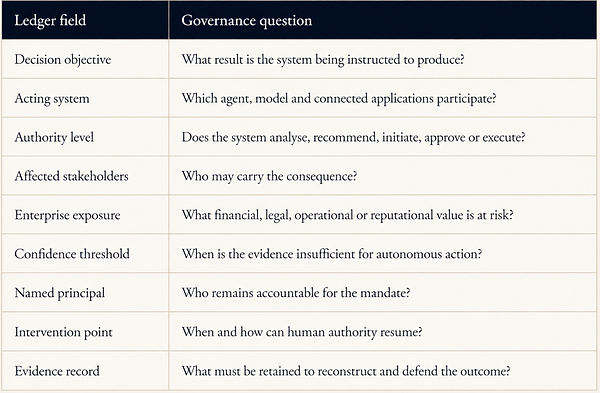
The ledger changes the quality of board oversight.
Instead of asking how many AI systems have been deployed, directors can ask which decisions have moved from people to systems since the previous meeting.
They can see:
decisions with no named principle
mandates whose authority level has expanded
cumulative exposure hidden beneath local thresholds
systems operating against conflicting objectives
human reviews that occur too late
evidence gaps that prevent reconstruction
A register alone will not create accountability.
It can, however, make the absence of accountability visible early enough to do something about it.
That is its real value.
08
The Governance Architecture Review and board scoring method
The ledger establishes what exists.
The Governance Architecture Review determines what should be permitted.
The level of autonomy should reflect the nature of the judgement, the consequence of error and the organisation’s practical ability to intervene.
A board can assess each material decision across seven dimensions.

Each dimension is scored from 1 to 5.
A score of 1 indicates limited governance exposure.
A score of 5 indicates significant exposure.
The weighted score helps determine the appropriate mode of authority.

Consider four decisions.

The score does not settle the decision.
A low value action may still require a person because it affects legal rights or sensitive judgement.
A high value action may sometimes be automated where the rules are objective, the evidence is reliable and the result can be reversed quickly.
The framework also prevents financial value from becoming the sole measure of materiality.
An inexpensive decision can still be serious.
A customer exclusion.
An employment recommendation.
A regulatory representation.
A supplier allegation.
The review should result in five practical outputs:
the approved mandate for each autonomous decision
the authority level permitted
the principal responsible
the intervention and evidence requirements
the assurance information required by the board
Some organisations will find the scoring uncomfortable.
That is useful.
It forces executives to state explicitly where they are prepared to let a machine exercise judgement and where they are not.
09
Questions every board should ask
Before approving a major market commitment, the board should expect clear answers to the following questions/
Which decisions have already moved from employee judgement to machine action?
The answer will not be found only in formally approved AI programmes.
Autonomy often enters through integrations, workflow changes and local initiatives that were never presented as transfers of authority.
Who owns an autonomous approval after the agent acts?
A department name is not enough.
Neither is the name of the platform.
The board should be able to identify the executive or role that owns the mandate and can alter it.
What value threshold requires human authority?
The answer should include cumulative exposure.
Thousands of individually small actions may create a larger risk than one visible capital decision.
Is human review genuine?
Can the employee see the relevant evidence?
Can they disagree without unreasonable friction?
Can they stop the process?
Can they reverse what has already happened?
A checkpoint that fails those tests is procedural, not substantive.
What happens when two agents create opposite obligations?
One agent is rewarded for retaining the customer.
Another protects margin.
A third enforces contractual policy.
All three may act correctly.
Who has authority when their objectives conflict?
Can the board evidence intervention rights before a regulator asks?
A policy stating that intervention is possible is not enough.
The organisation should be able to show when intervention is required, who can perform it and whether it occurs before the outcome becomes irreversible.
What happens when the system is right but the outcome is wrong?
An agent may follow the approved rules precisely.
The company may still create an unfair, commercially irrational or strategically damaging result.
Correct execution does not remove responsibility for the mandate.
Is there a complete inventory of autonomous decisions?
A list of models and applications is not the same thing.
The board needs visibility over decisions, authority levels and stakeholder consequences.
Can every material outcome be traced to a principal and reliable evidence?
The explanation should not depend entirely on the vendor.
The enterprise should retain enough information to reconstruct its own action.
Which decision should never be made autonomously?
Every organisation should know where it will not delegate judgement, even when the technology becomes capable of performing the task.
The answer often reveals more about the board’s real risk appetite than the formal policy does.
What changed since the previous board meeting?
New integrations, higher limits and revised workflows can alter the practical mandate without changing the original use-case description.
Is the board receiving assurance over technology or over enterprise decisions?
Those are different assurances.
One establishes that the infrastructure is controlled.
The other establishes that the company can still account for what it does.
These questions should be answered before autonomous work becomes ordinary.
Once a decision is embedded across systems, functions and performance measures, redesign becomes far harder than approval at the beginning.
10
Closing perspective
Autonomous work will expand because the economics are compelling.
Systems can operate continuously.
They can process more information than an individual employee.
They can coordinate across applications, identify patterns and complete routine decisions faster than conventional management structures.
The attraction is obvious.
The enterprise may, however, increase the number of decisions it can make before it increases its ability to govern them.
At first, the gap appears manageable.
The decisions are narrow.
The thresholds are low.
A person remains somewhere in the workflow.
Then the decisions connect.
A customer decision changes finance.
A procurement action creates a legal obligation.
A workforce recommendation affects an individual’s opportunity.
A compliance agent determines which matter receives human attention.
The system does not need an executive title to begin exercising enterprise authority.
It needs permission to act. Boards should not attempt to supervise every autonomous decision. That would remove much of the value.
They should make sure the architecture of authority remains deliberate.
The decision must be identifiable.
The mandate must be understood.
The limits must be real.
Someone with practical power must remain accountable.
Intervention must occur early enough to matter.
Evidence must survive the outcome.
The objective is not to slow artificial intelligence until every risk disappears. That would be neither credible nor commercially useful.
The objective is to stop technical capability becoming delegated authority without a conscious enterprise decision.
The boardroom question is changing.
It is no longer enough to ask whether the organisation is using AI responsibly.
Directors must also ask where autonomous authority now exists and whether the company can still account for every material consequence it creates.
Some enterprises will answer that question early and scale with greater confidence.
Others will move just as quickly.
They may simply discover later that speed and control were not expanding together.
Before autnomous work scales further,
answer one question:
If a material decision were challenged tomorrow, could the board identify who authorised it, who owned it and why the system was permitted to act?
Most organisations can identify the artificial intelligence systems they have deployed.
Far fewer can identify every material decision those systems may recommend, initiate, approve or complete.
That gap becomes consequential when authority moves faster than accountability.
Our work is normally undertaken before autonomous decision-making becomes deeply embedded across functions or before boards require formal assurance over decision ownership.
Where a wider strategic mandate is unnecessary, we will say so.
An Autonomous Governance Review examines:
Decision inventory
Which material decisions have moved from human judgement to autonomous analysis, recommendation, initiation, approval or execution.
Authority architecture
What each system is permitted to do and whether the practical mandate matches the organisation’s formal delegation structure.
Named accountability
Who remains answerable for each decision and whether that person has genuine authority to intervene.
Thresholds and escalation
Where uncertainty, economic value, stakeholder impact or conflicting objectives require human judgement.